 Ahmadreza Samadi / Home
Everyday ideas, explained
How many coffees must a cafe sell before it makes any profit?
One hundred coffees. Five hundred dollars in sales. Zero operating profit. A busy counter can still be a day spent covering costs. Here is the maths through one fictional cafe.
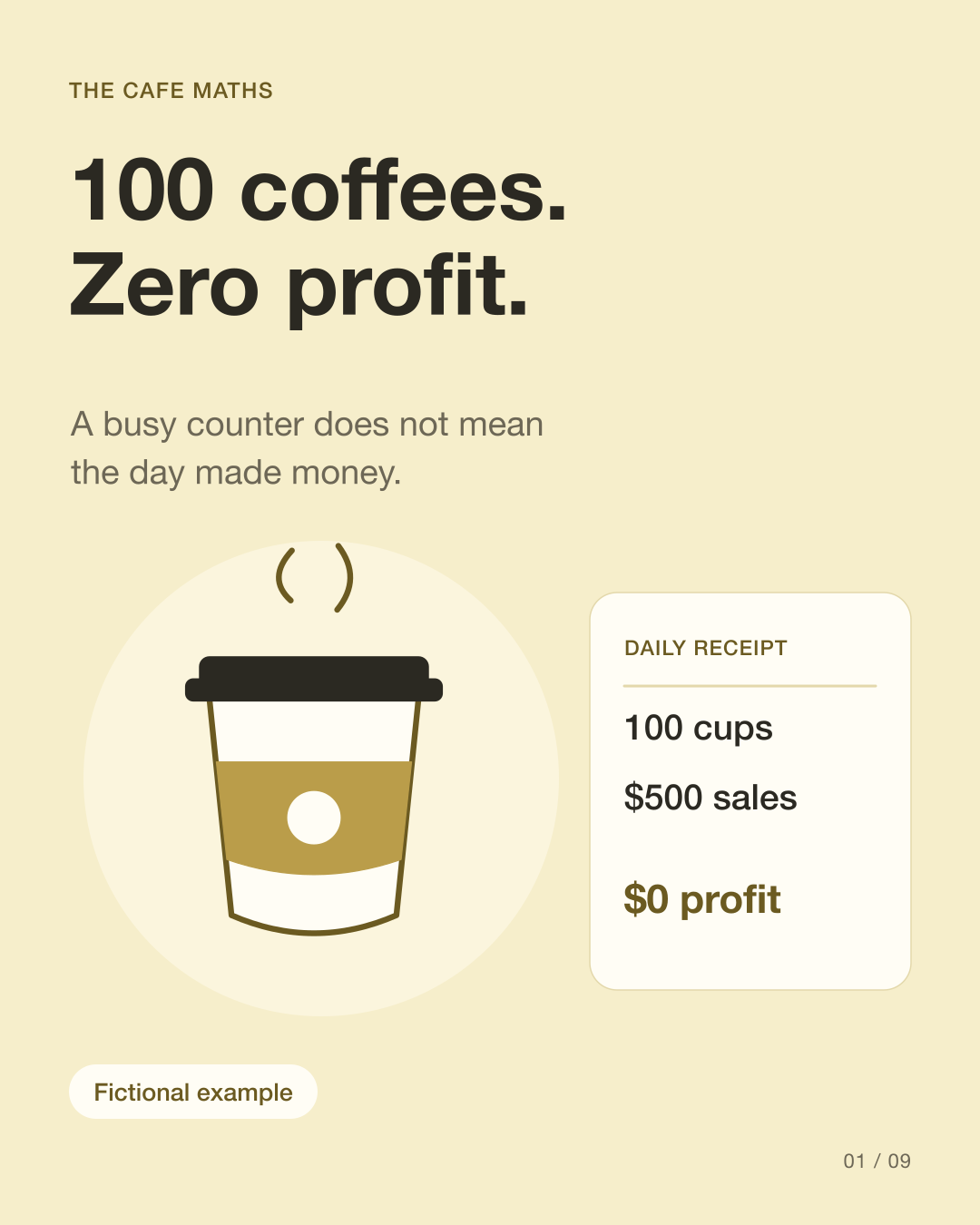
Price
$5 for each coffee.
Contribution
$3 per cup remains after $2 of per-sale costs.
Break-even
100 cups cover $300 of daily overhead.
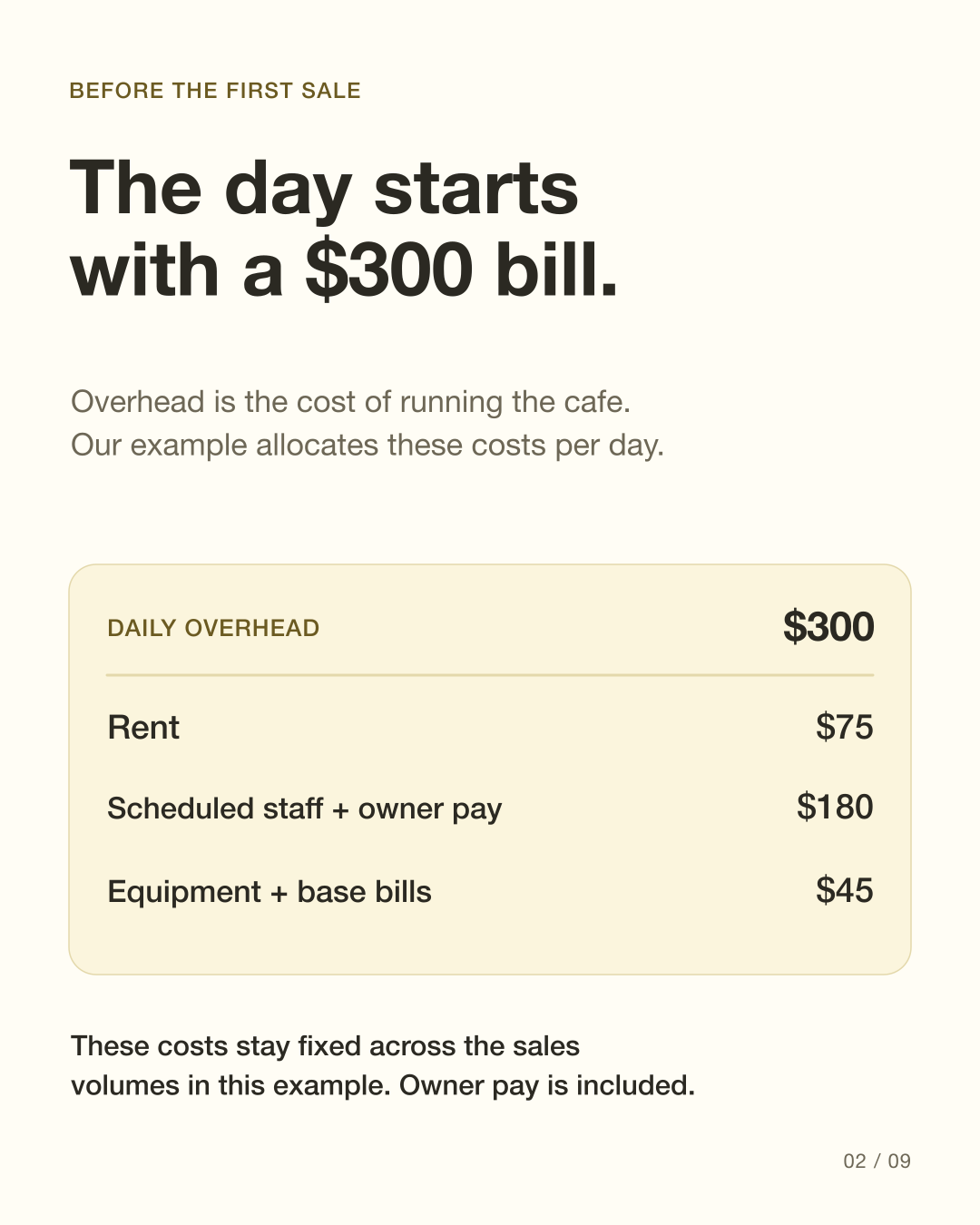
The day starts with costs
Our fictional cafe sells only one kind of coffee. It allocates $300 of overhead to each trading day: $75 of rent, $180 of scheduled staff and owner pay, and $45 of equipment and base bills. Overhead means the cost of running the business before considering each individual sale. These costs stay fixed over the sales volumes shown.
Source: U.S. Small Business Administration: Break-even point · University of Missouri Extension: Break-even Pricing, Revenue and Units
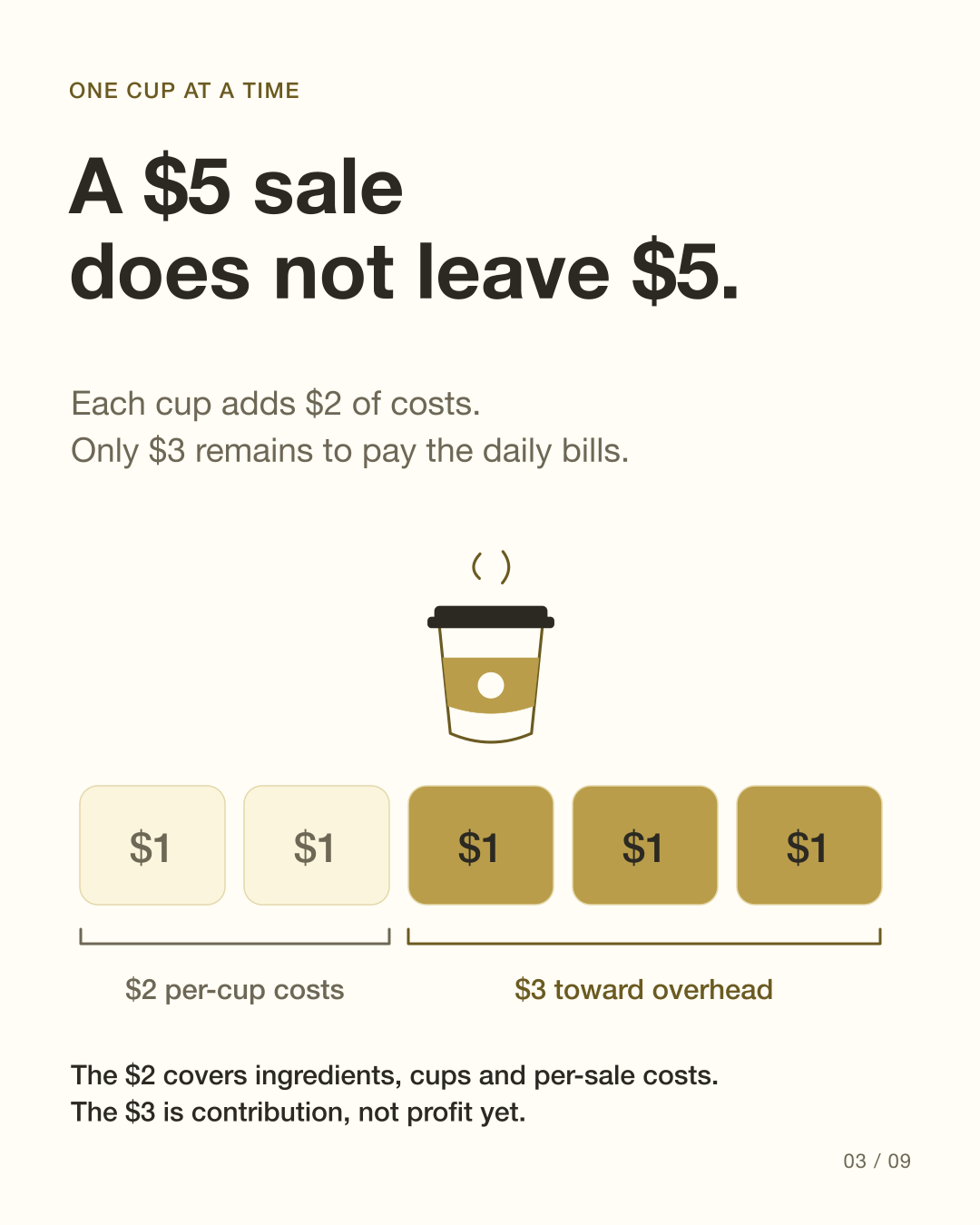
A $5 sale does not leave $5
Each coffee adds $2 of costs for ingredients, the cup and all other assumed per-sale costs, including card fees. Subtract that from the $5 price and $3 remains to pay the daily overhead. This remainder is contribution per cup. It is not profit while the overhead is still uncovered.
Source: U.S. Small Business Administration: Break-even point · University of Missouri Extension: Break-even Pricing, Revenue and Units
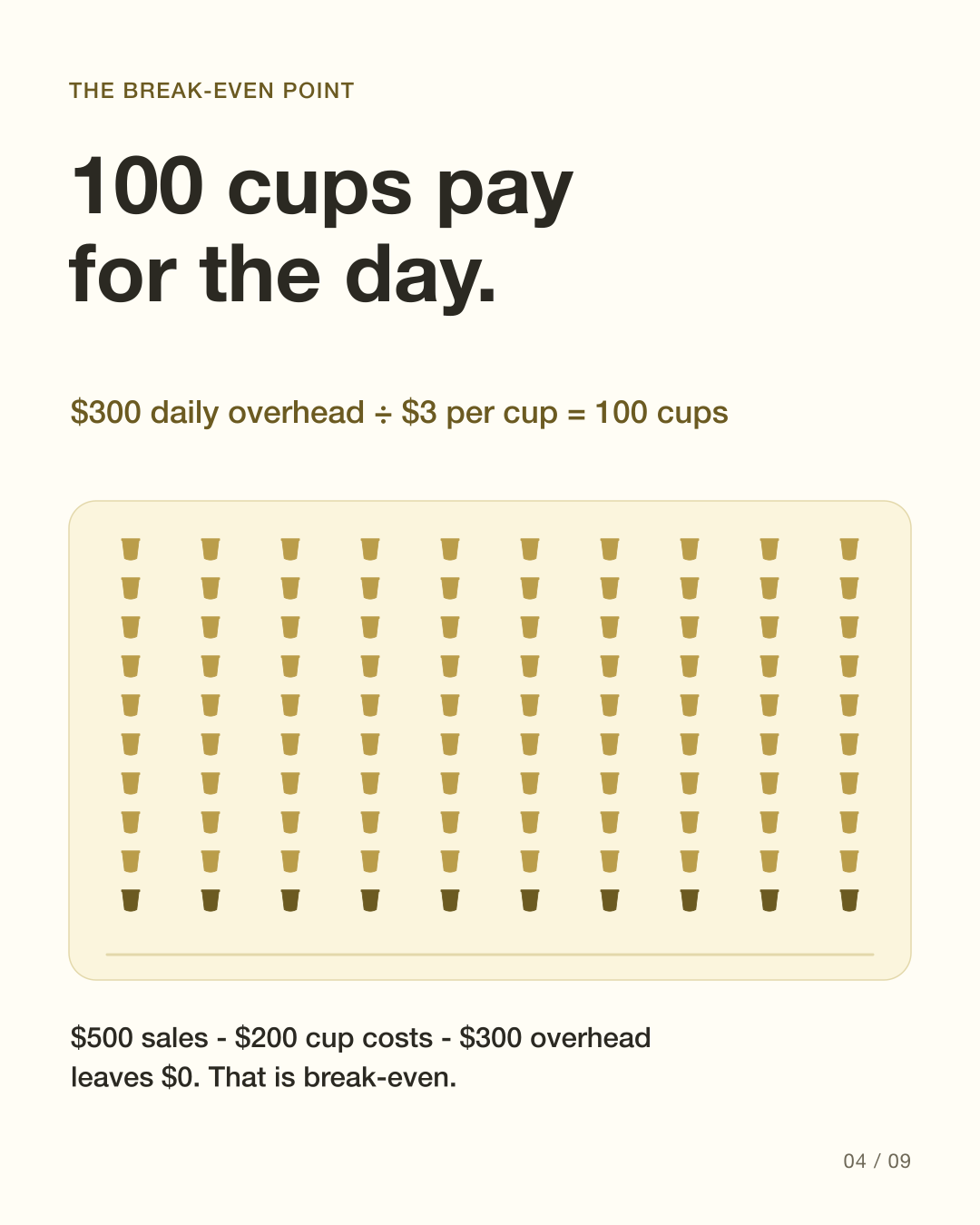
100 cups pay for the day
Divide daily overhead by contribution per cup: $300 ÷ ($5 - $2) = 100 cups. At 100 sales, revenue is $500, per-cup costs total $200 and overhead is $300. The result is $0. This is break-even: the sales cover the model's operating costs, with no operating profit or loss.
Source: U.S. Small Business Administration: Break-even point
Why dividing by the price gives the wrong answer
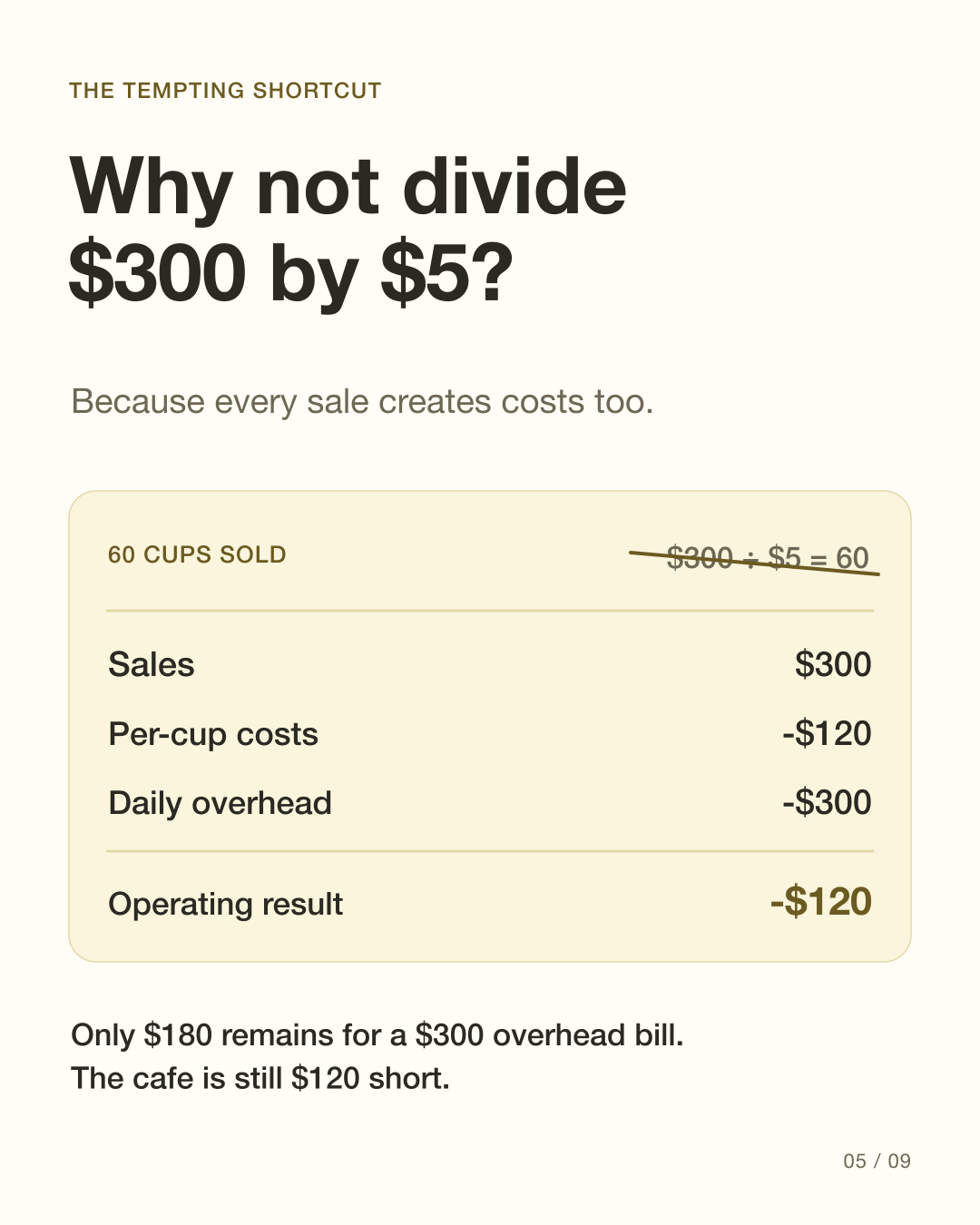
Dividing $300 by the $5 price suggests 60 cups. But those sales also create $120 of per-cup costs. Only $180 of the $300 revenue remains toward overhead. After the $300 overhead, the model still has a $120 operating loss. Revenue is not the amount available to cover fixed costs.
Source: U.S. Small Business Administration: Break-even point
What happens after cup 100?
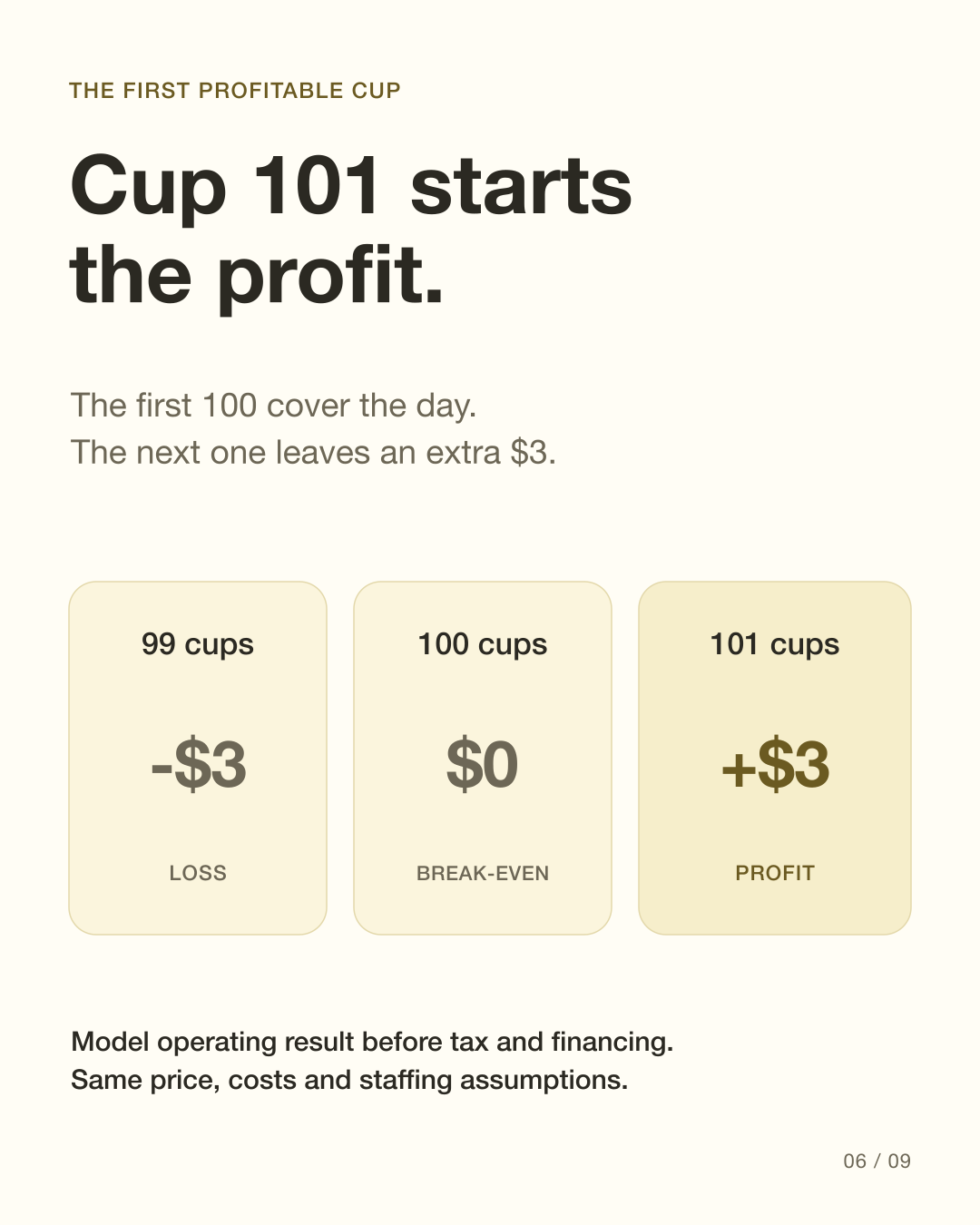
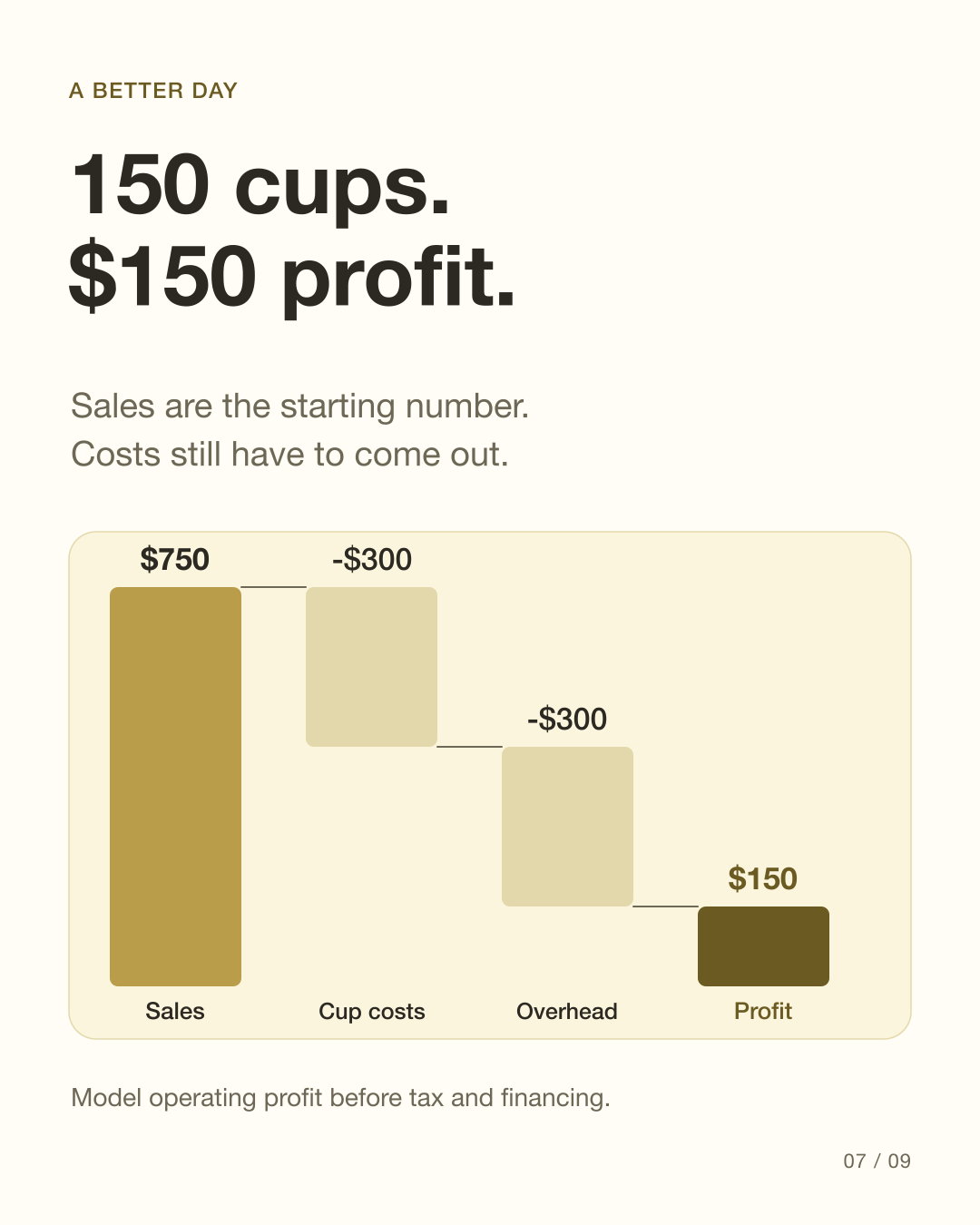
At 99 cups, the operating result is a $3 loss. At 101 cups, $303 of contribution covers the $300 overhead and leaves $3 of operating profit. At 150 cups, the calculation is $750 revenue - $300 per-cup costs - $300 overhead = $150 operating profit. These results are before tax and financing, and scheduled owner pay is already included in overhead.
Source: U.S. Small Business Administration: Break-even point · University of Missouri Extension: Break-even Pricing, Revenue and Units
A lower price changes the target
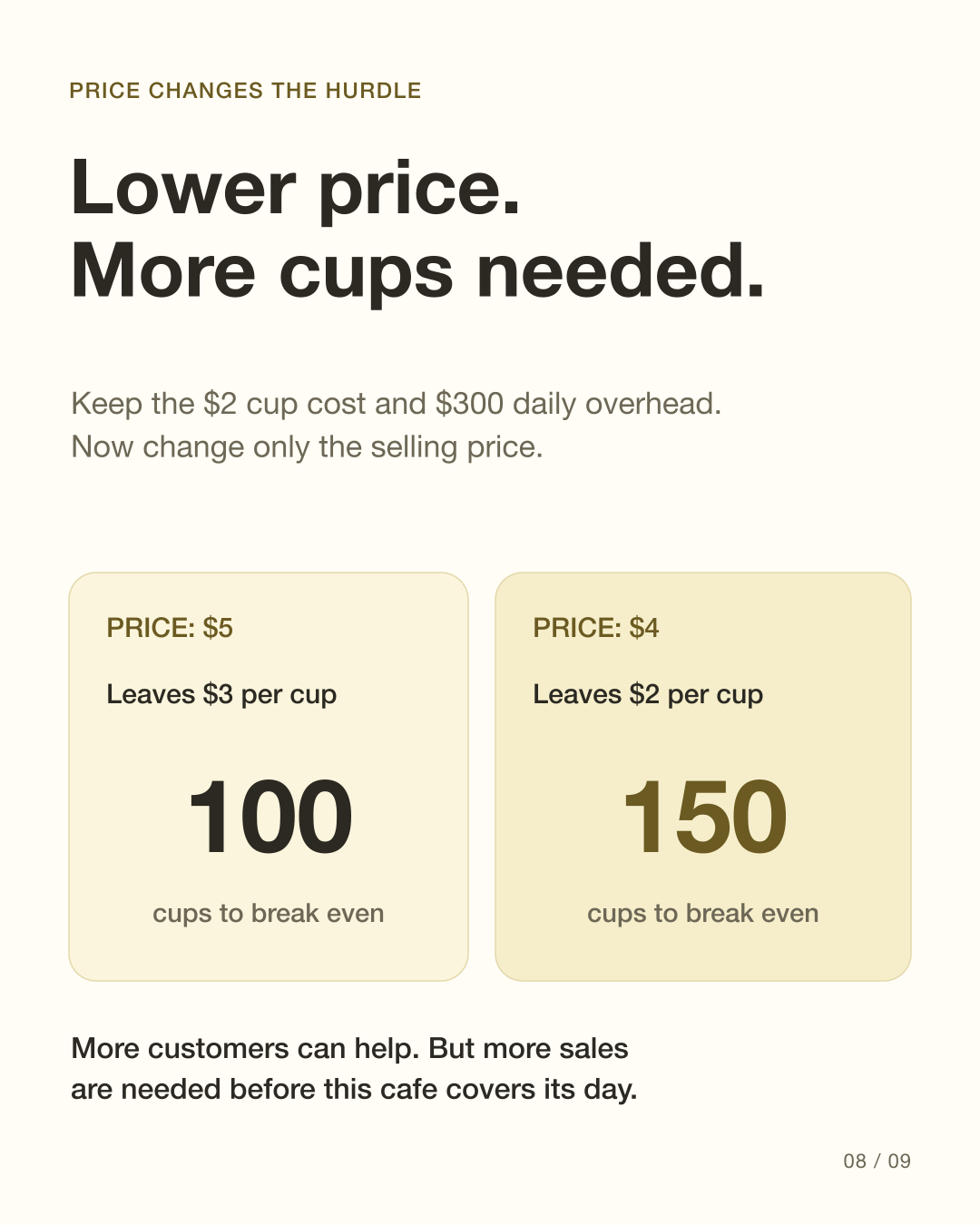
Reduce the price to $4 while leaving the $2 unit cost and $300 daily overhead unchanged. Contribution falls to $2, so break-even becomes $300 ÷ $2 = 150 cups. A lower price might attract customers, but it also raises the sales volume needed to cover these costs. This example makes no prediction about demand.
Source: U.S. Small Business Administration: Break-even point · University of Missouri Extension: Break-even Pricing, Revenue and Units
Use the question, not the fictional benchmark
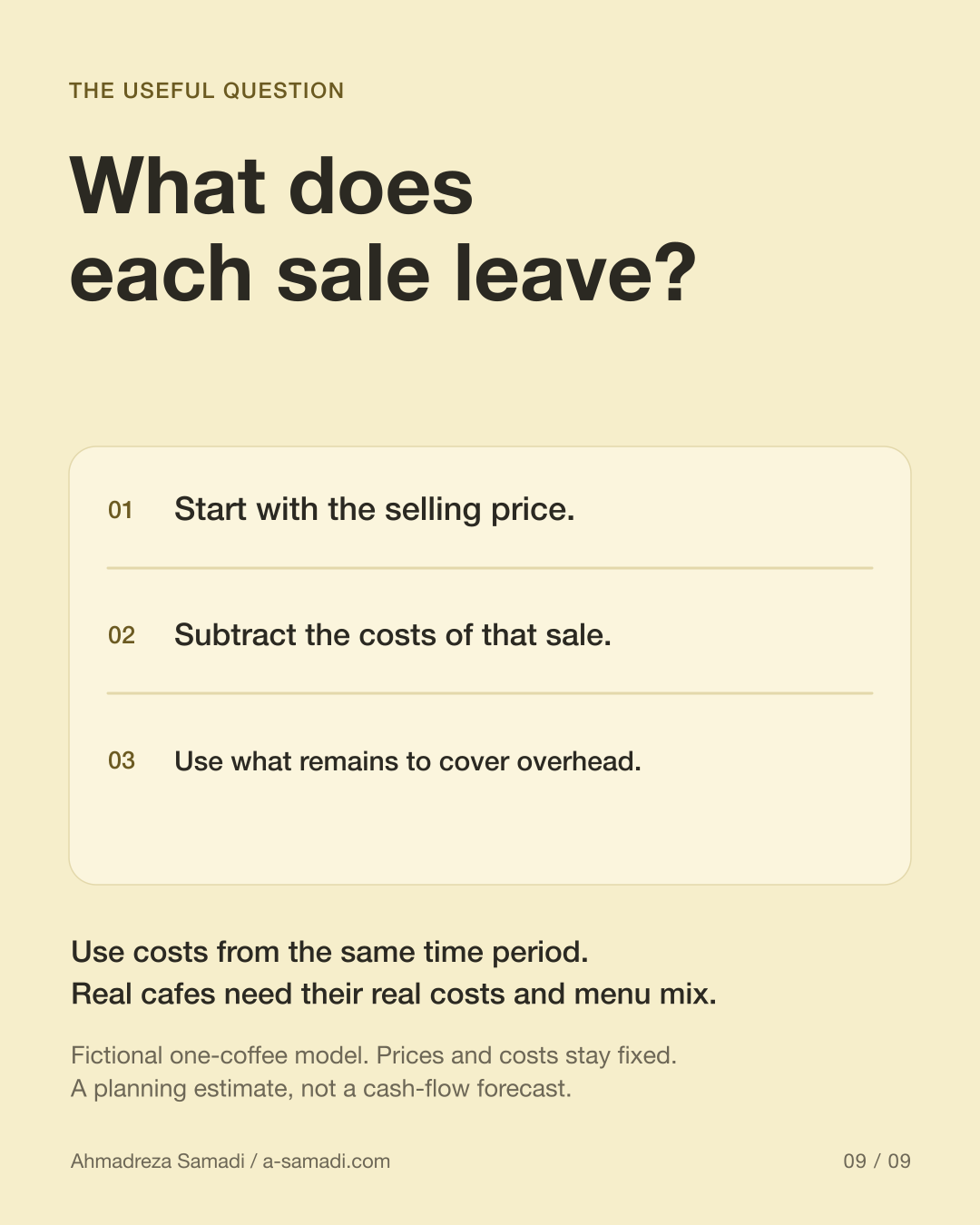
Find the price minus the per-sale cost, then divide the period's fixed costs by that positive remainder. Use the same time period and round up when the result is a fraction of a unit. All amounts here are fictional US dollars. The model assumes one product, constant prices and costs, and enough staffing capacity for the volumes shown. Real cafes need actual costs, menu mix, waste, demand and staffing limits; some costs change in steps as volume grows. Break-even is a planning estimate, not a cash-flow forecast or a measure of startup investment payback.
Source: U.S. Small Business Administration: Break-even point · University of Missouri Extension: Break-even Pricing, Revenue and Units
See the explanation in slides
These original diagrams explain the mechanism. The carousel is in English.
View all 9 English slides
Download the English carousel PDF
Sources
Primary references checked on 10 October 2026. Product support and behavior can vary.