 Ahmadreza Samadi / Home
Technology and proptech, explained
How can a smaller AI model fit a useful task?
A smaller AI model can be useful when it meets a clearly defined task's needs. Start with the required answer, test difficult cases and keep a route for exceptions. A lower call price is useful only within a workflow that produces acceptable results.
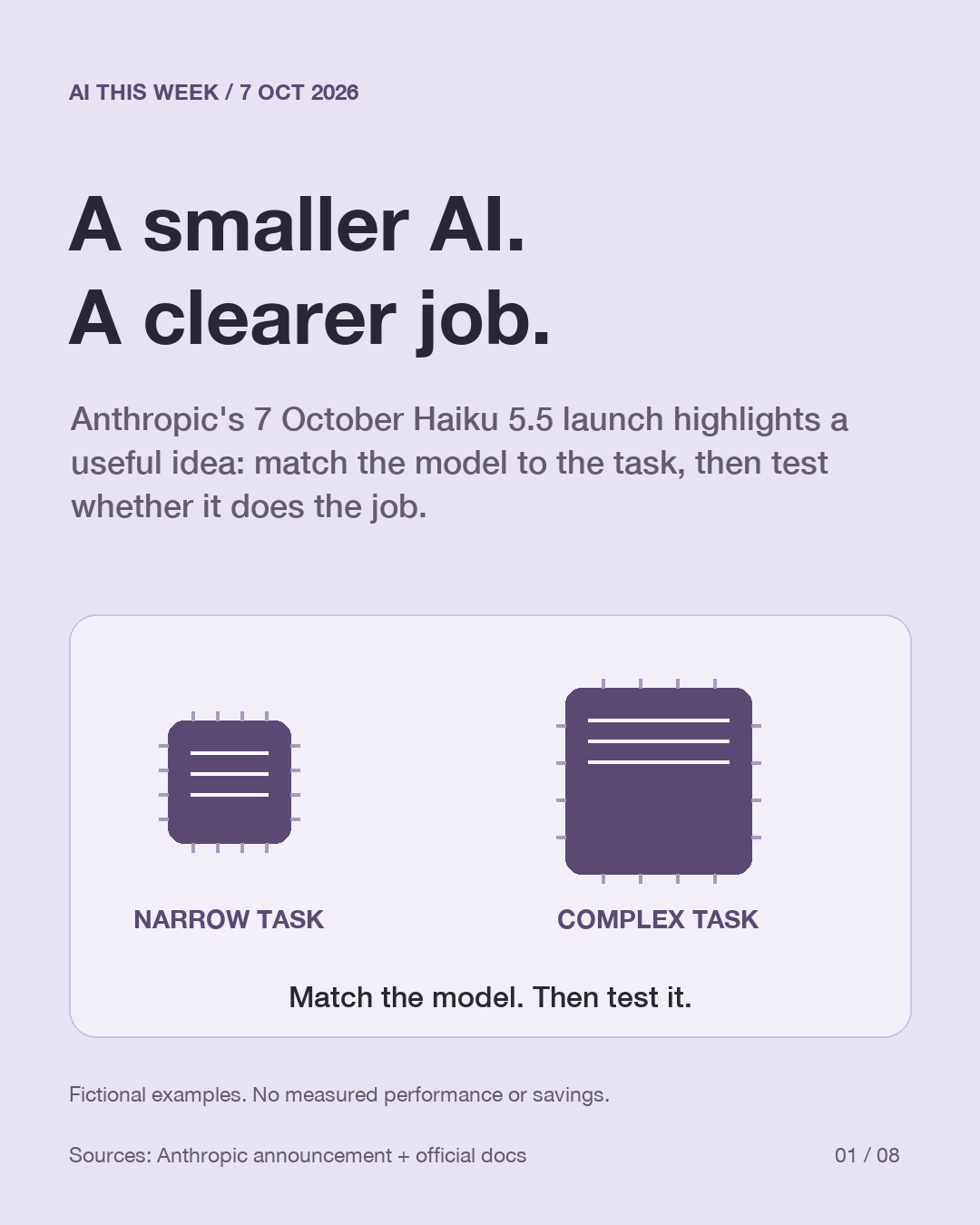
Define the job
Use a narrow task with clear output rules and a review path.
Test the result
Check known and ambiguous examples, errors and response time.
Count the whole cost
Model calls, retries, tools, routing and review all affect cost per accepted result.
Why discuss smaller models this week?
Anthropic introduced Haiku 5.5 on 7 October 2026 for narrow, repeated work. Its announcement still distinguishes larger models for complex tasks. That dated release is the current-news connection for this explanation, not proof that a smaller model is best for every task or that its vendor benchmarks predict your results.
Source: Anthropic: Introducing Claude Haiku 5.5 · Anthropic: Claude Haiku model page
What does a bounded task look like?
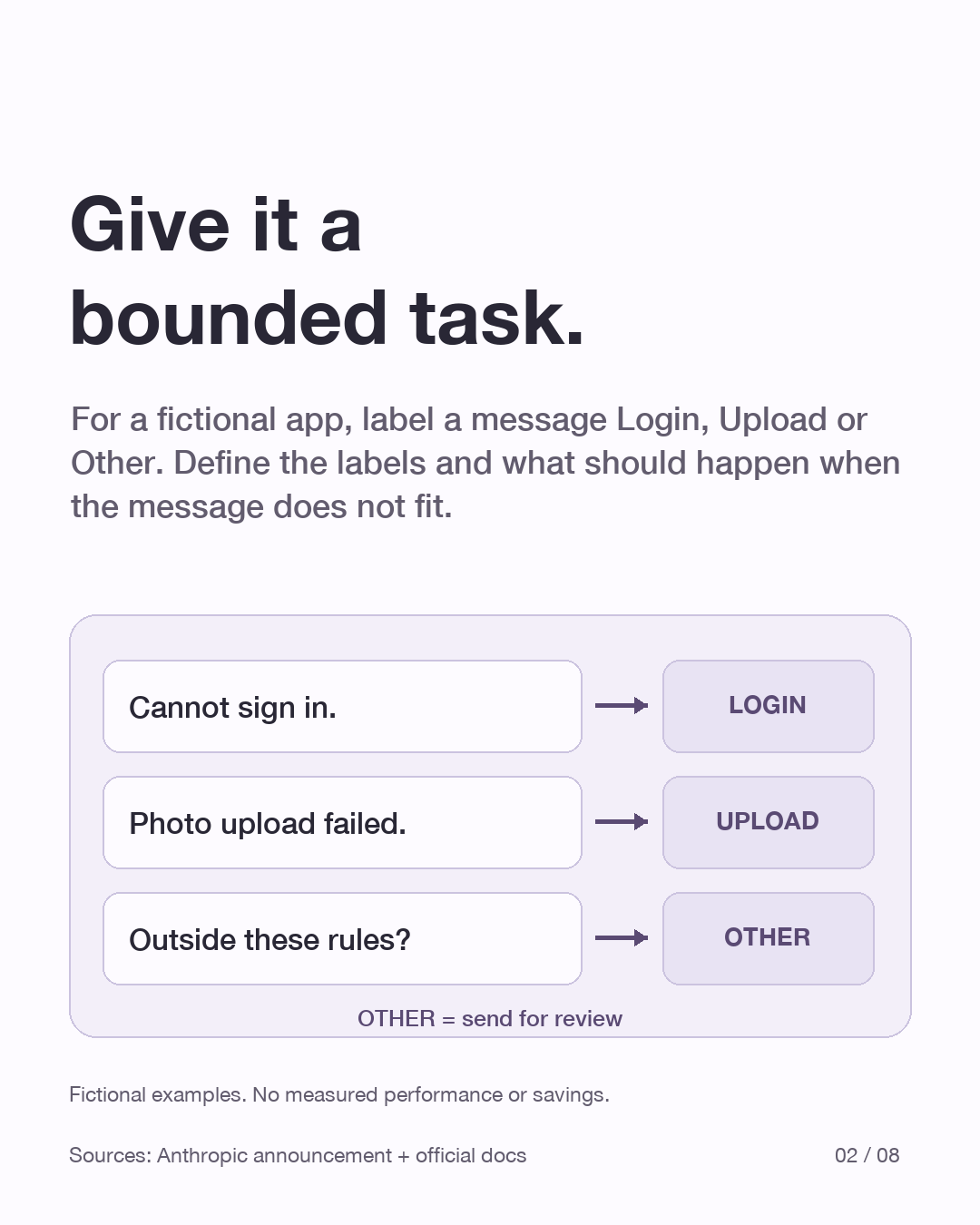
Our fictional app receives support messages. The task is to label each message Login, Upload or Other, using explicit rules. Cannot sign in is an illustrative Login case; Photo upload failed is an illustrative Upload case. A message outside the defined categories goes to review. These are expected labels in an original example, not actual model outputs. Clear task boundaries make evaluation possible.
Source: Claude Platform: Define success criteria and build evaluations
How do you check whether it works?
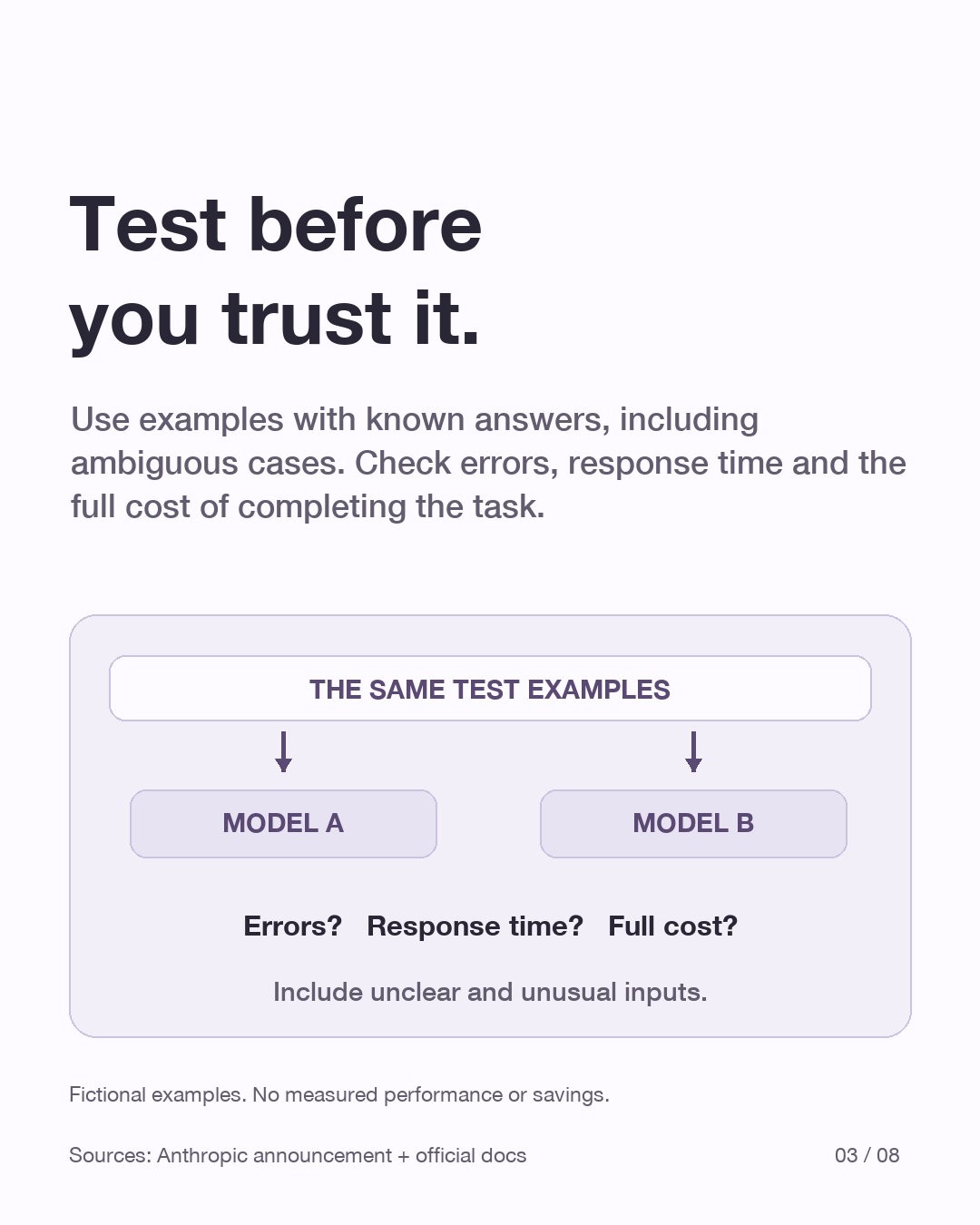
Use examples with known answers and include ambiguous, unusual and incomplete inputs. Compare candidates on the same relevant task set. Check errors, consistency, response time and cost against the requirements you defined. A convincing answer or a model saying it is confident does not establish correctness. This is a suggested evaluation process; no model was tested for this post.
Source: Claude Platform: Define success criteria and build evaluations
What is routing?
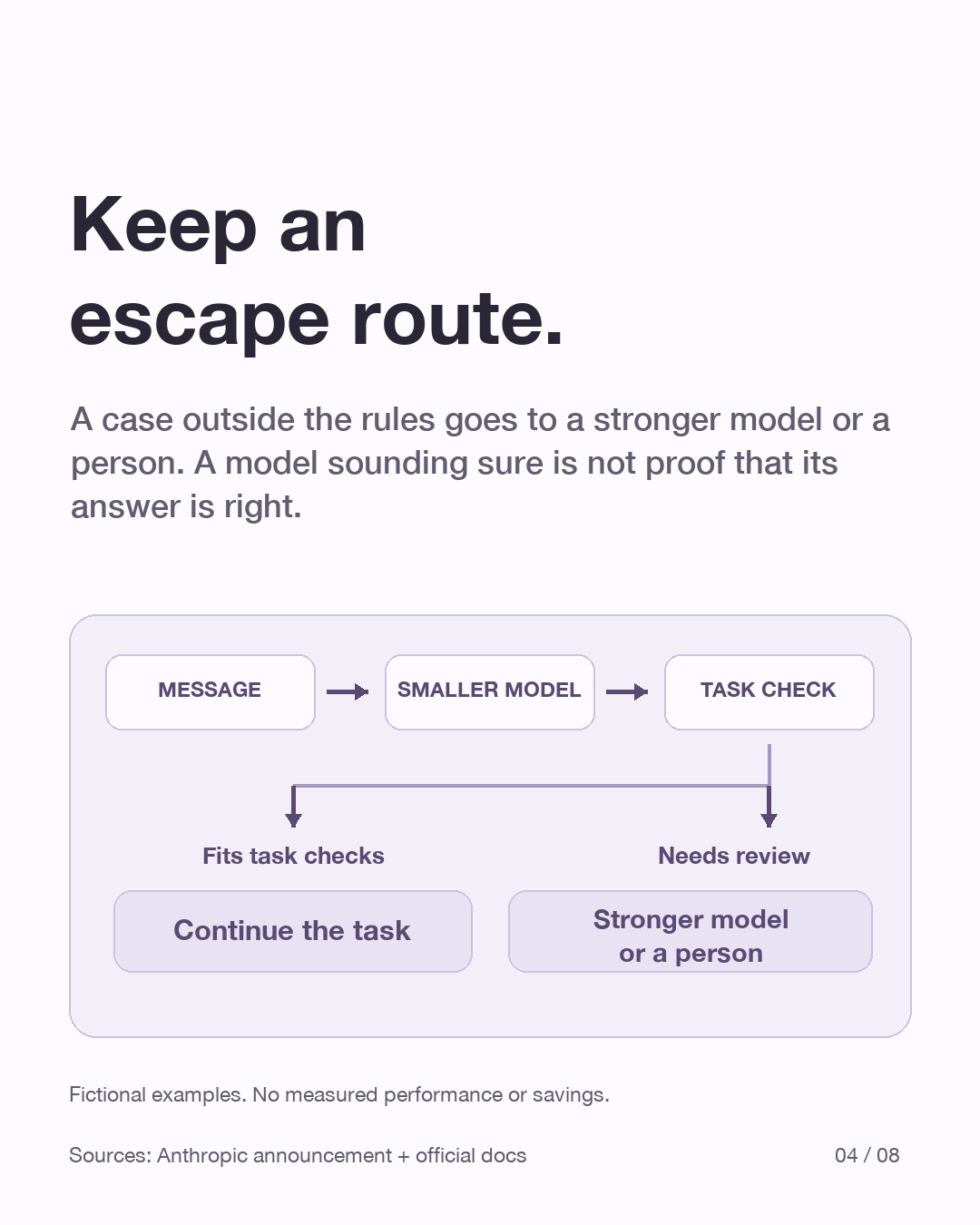
Routing chooses a path for the work. A narrow repeated task may go to a smaller model. An unclear result, a failed check or a complex request can go to a stronger model or a person. Define that fallback explicitly and check its result too. A stronger model is another candidate, not an automatic guarantee that the difficult case is solved. The diagram is a conceptual design, not a deployed system.
Source: Anthropic: Introducing Claude Haiku 5.5 · Claude Platform: Define success criteria and build evaluations · Anthropic: Claude Haiku model page
How does the fictional calculation work?
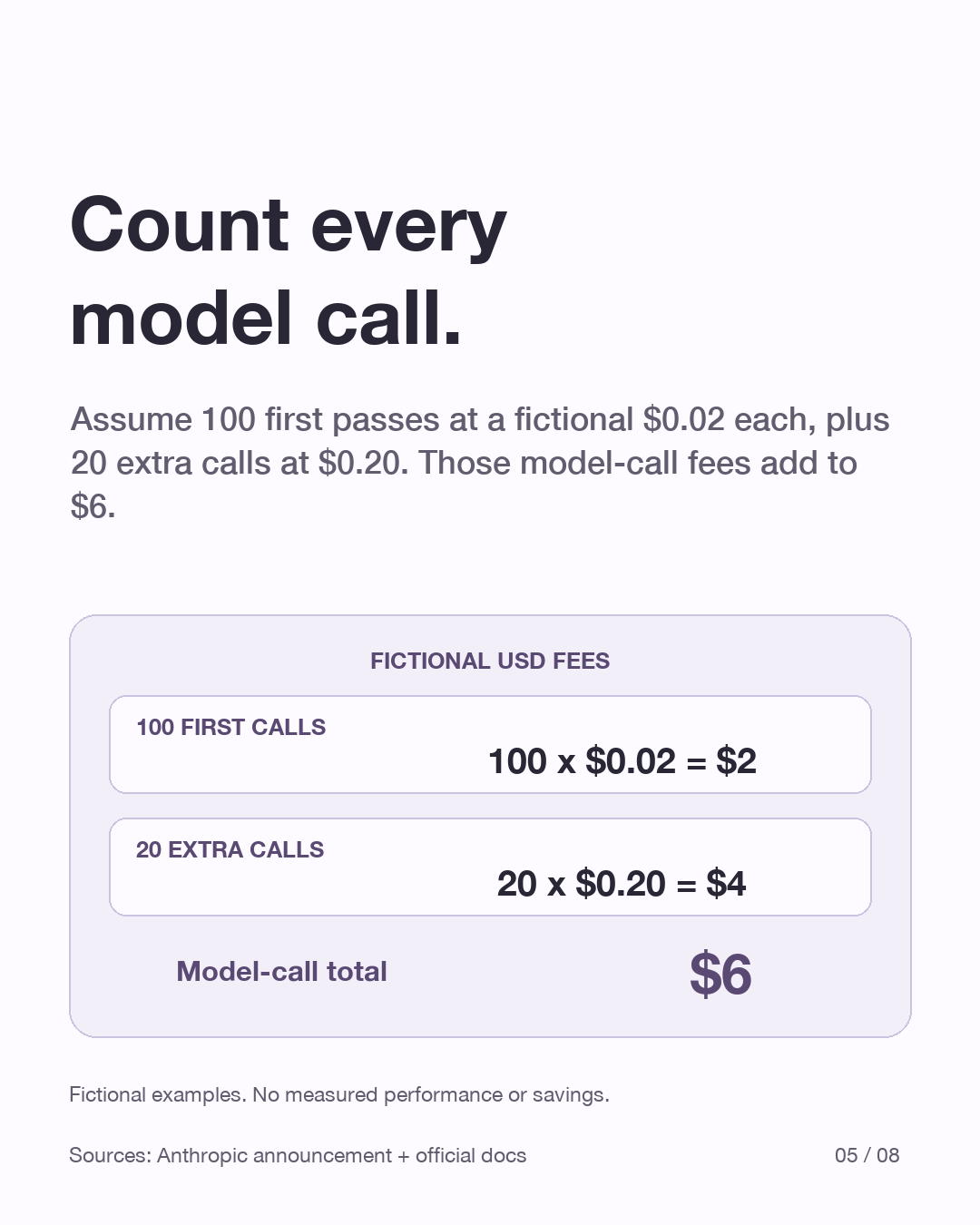
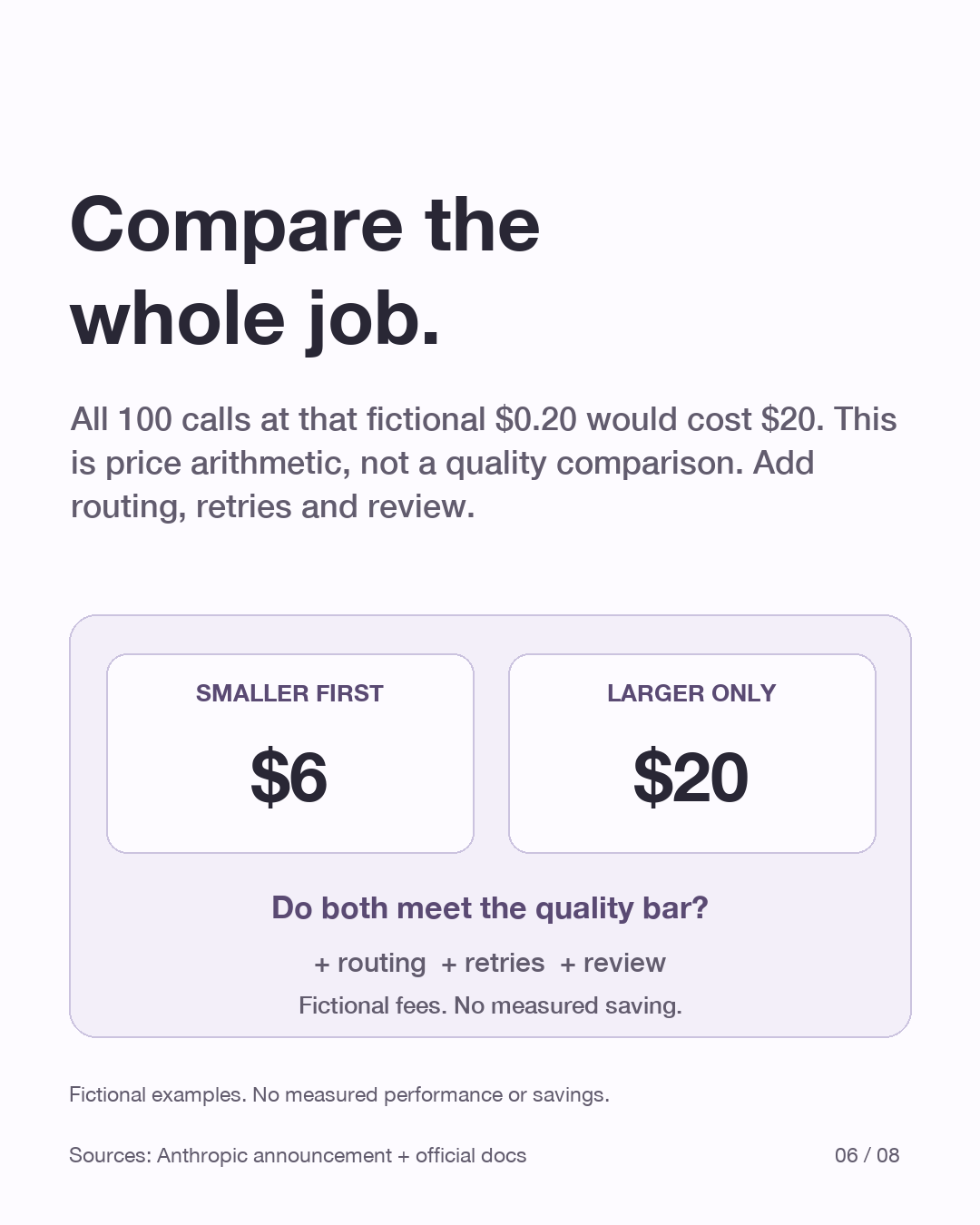
Assume 100 requests each get an initial call at an invented USD 0.02 fee: 100 x 0.02 = USD 2. Assume 20 requests need an extra call at an invented USD 0.20 fee: 20 x 0.20 = USD 4. The model-call total is USD 6 across 120 calls. Sending all 100 initial requests down the USD 0.20 route would give 100 x 0.20 = USD 20. These fees and the 20 escalations are fictional assumptions, not Haiku prices, model error rates, measured savings or evidence of equal output quality.
What is missing from that call total?
The arithmetic omits routing overhead, retries, tool charges and the time a person spends checking outputs. It also does not show how many outputs pass review. Compare full cost per accepted result only after each candidate meets the relevant quality bar. A cheaper attempt that requires more correction can change the result. The cost example illustrates a question to measure, not a forecast of a company's savings.
Source: Claude Platform: Define success criteria and build evaluations · Claude Platform: Pricing
What should you check before choosing?
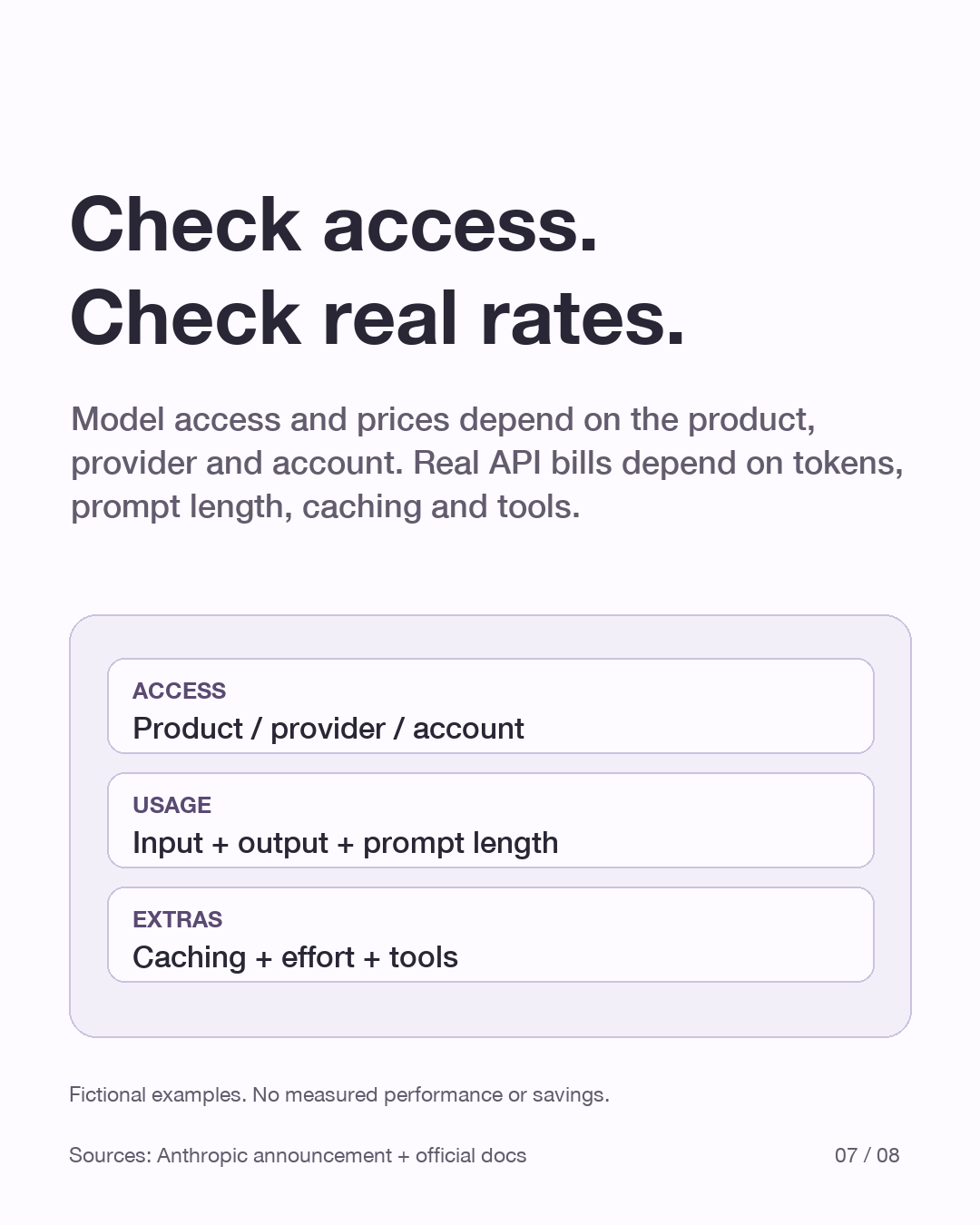
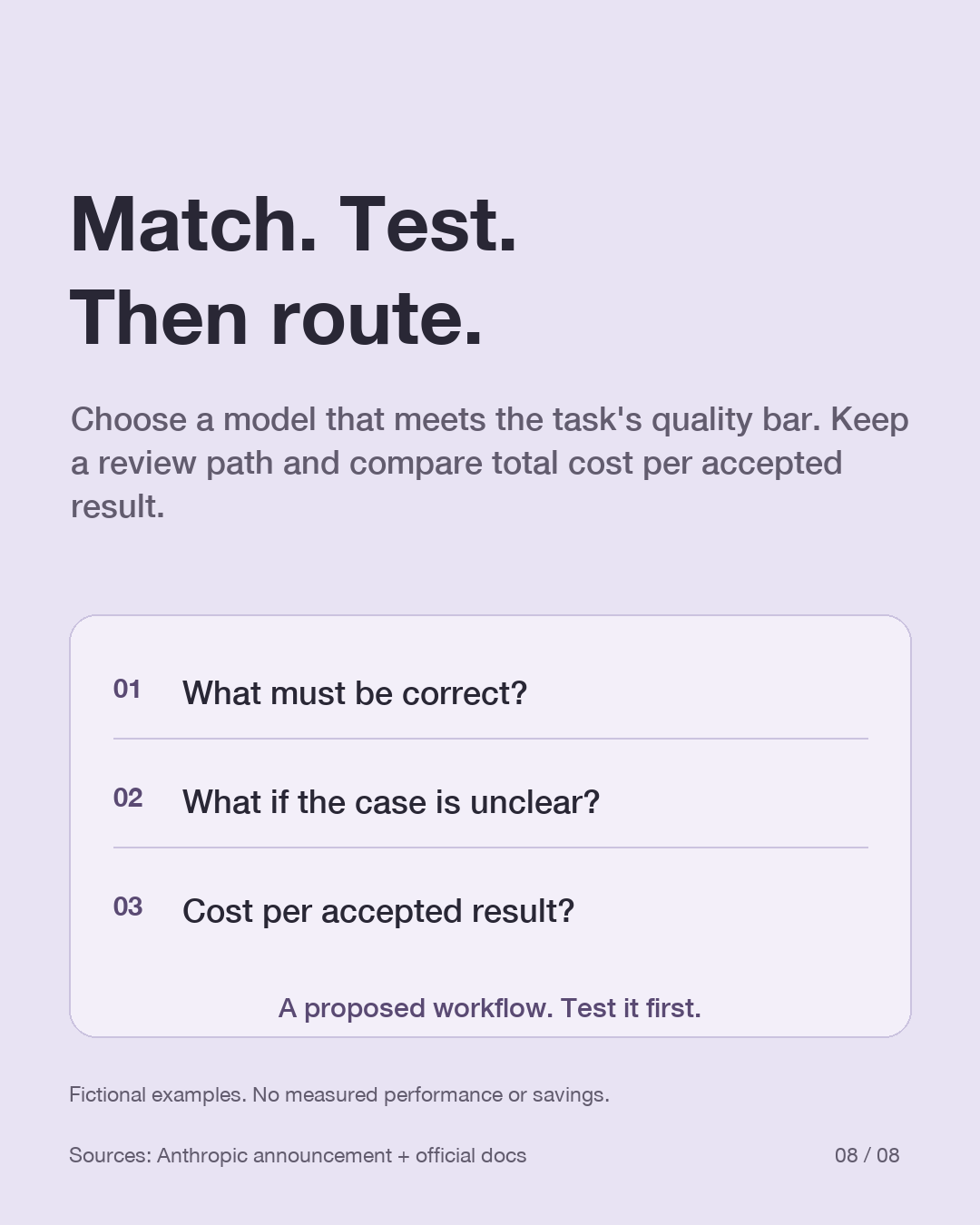
Check the current model access for the product, provider and account you intend to use. Read the current API pricing rather than treating a model name as a flat per-call rate or assuming a subscription covers a workload. Input/output usage, prompt length, caching, effort and tools can affect the bill. Match the task, test its outputs, keep a review route and compare the complete workload.
Source: Anthropic: Introducing Claude Haiku 5.5 · Claude Platform: Pricing · Anthropic: Claude Haiku model page
See the explanation in slides
These original diagrams explain the mechanism. The carousel is in English.
View all 8 English slides
Download the English carousel PDF
Sources
Primary sources checked on 2026-10-12. Dated announcements and operator reports are attributed in the explanation; availability and terms can change.